The State of AI in Mid-2026: What Actually Matters for Data Teams
In 2024, most enterprise AI conversations revolved around one question: which model is best? By mid-2026, that question has become almost secondary. Organizations are discovering that deploying AI successfully was never primarily a model-selection problem — it’s a data, governance, and architecture problem. The model is the easy 10%.
The numbers back this up, though not in the way the loudest headlines suggest. Gartner expects task-specific AI agents to be embedded in 40% of enterprise applications by the end of 2026, up from under 5% in 2025 — one of the fastest capability rollouts in enterprise software history (Gartner, 2025). But Gartner’s own Hype Cycle for Agentic AI, 2026 puts actual deployment today at just 17% of organizations, even as more than 60% say they plan to deploy within two years (Gartner, 2026). Separately, Gartner predicts that over 40% of agentic AI projects will be canceled by the end of 2027 — not because of model quality, but because of escalating costs, unclear business value, and inadequate risk controls (Gartner, 2025).
McKinsey’s most recent State of AI survey tells the same story from the inside: 88% of organizations now use AI regularly in at least one business function, yet only 23% have scaled agentic AI into even a single function, and in no individual function does scaled use top roughly 10% (McKinsey, 2025). And MIT’s widely cited 2025 NANDA study found that 95% of enterprise generative AI pilots never produce a measurable financial return — only about 5% do (MIT NANDA, 2025).
Everyone is deploying something. Almost nobody is scaling it. This is the story of why, and what closes the gap.
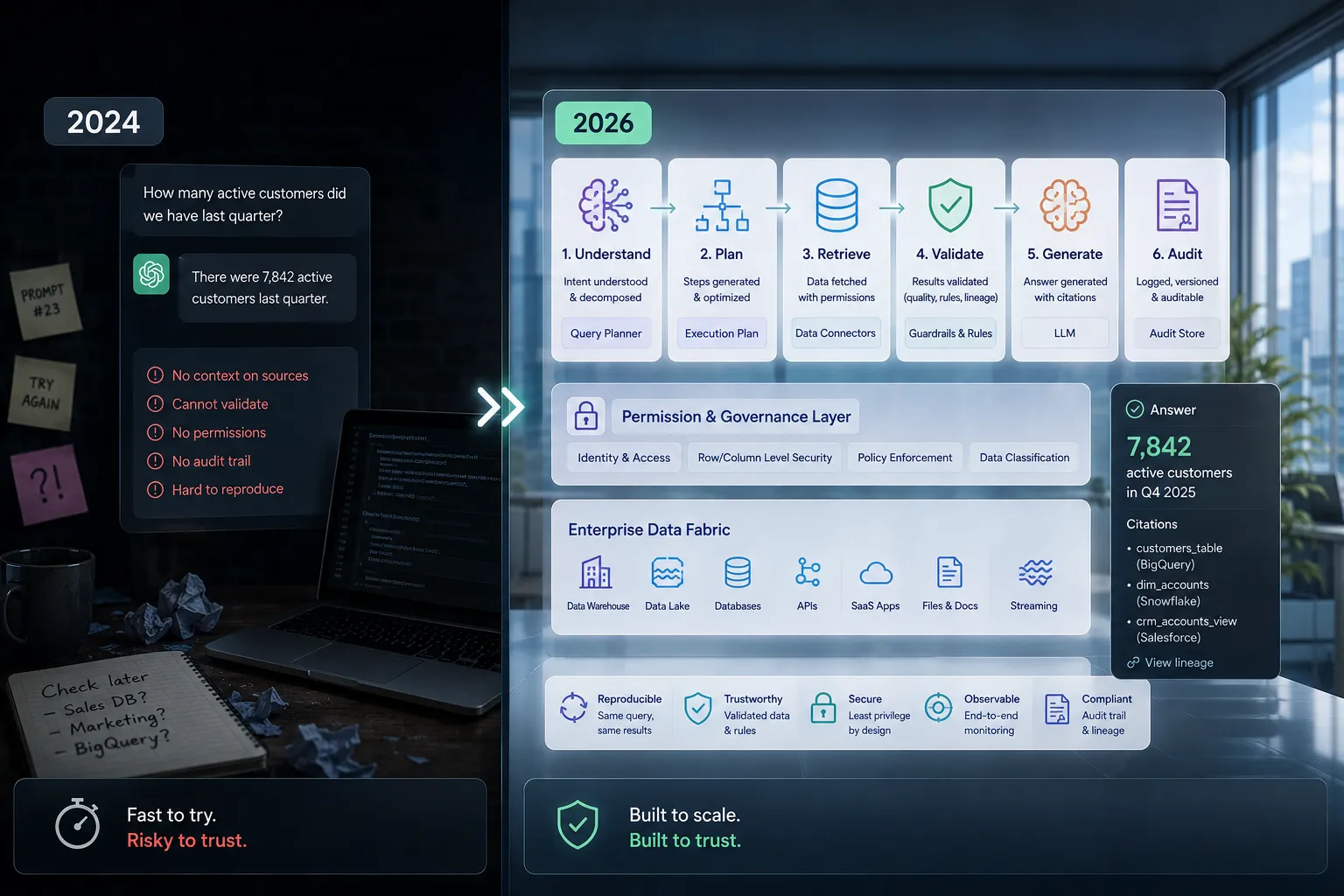
What changed between 2024 and 2026 isn’t the model in the middle — it’s everything the organization had to build around it.
The Real Bottleneck Keeps Moving
Every year of this cycle has had its own bottleneck, and each one has been solved just enough to expose the next one underneath it:
- 2023 — the models themselves. Capability was the limit. Most tasks a model attempted, it did badly.
- 2024 — prompt engineering. Models got capable enough that the limiting factor became how well you could instruct them.
- 2025 — retrieval. Prompting stopped being the bottleneck once retrieval-augmented generation let models pull in outside context, but retrieval quality became the new ceiling.
- 2026 — enterprise data quality, governance, and permissions. Retrieval and tool-calling are now commodity capabilities.
Gartner names the same three culprits behind this year’s project cancellations — cost, unclear ROI, and weak risk controls — and notes that only a small fraction of the thousands of vendors claiming “agentic” capabilities are doing anything more than rebranding a chatbot, a pattern it calls “agent washing.”
The bottleneck isn’t intelligence anymore. It’s trust — and the systems built to earn it.
Reasoning Stopped Being a Demo Trick
A year ago, reasoning models were mostly benchmark curiosities — impressive on olympiad-style math problems, overkill for a support ticket. That’s no longer true. Models that deliberate through intermediate steps before answering are now the default choice for any task with more than one moving part, because they catch their own mistakes before a person has to. We covered this shift in depth in The Reasoning Revolution.
For data work specifically, this matters more than it sounds. A question like “why did churn spike in the Northeast region last quarter” isn’t one query — it’s a chain of hypotheses, joins, and refinements. Reasoning models are finally reliable enough to hold that chain together across multiple steps without drifting into a plausible-sounding but wrong answer.
Agents Became the Product, Not the Pitch
Chat interfaces were the first wave of enterprise AI. The current wave is agents that plan, call tools, check their own output, and only surface a result once it’s been verified against something real — a data warehouse, a document store, a scheduling system. Standards such as the Model Context Protocol have made the plumbing dramatically easier: connecting an LLM to a database is now close to a solved problem.
But MCP and protocols like it solve connection, not correctness. They don’t decide whether the agent was authorized to see a given row, whether it understood what a column actually means semantically, or whether the query it generated is the one you’d have written yourself.
Connecting an agent to enterprise data is now easy. Connecting it safely, and producing an answer you can trust, is still the hard engineering problem — the one Gartner’s own analysis says is costing agentic AI projects their funding.
Context Windows Made “Read Everything First” Viable
Long-context models can now hold an entire codebase, a full quarter of support logs, or a complete contract in a single pass. That quietly removes a huge amount of manual chunking and stitching that used to be necessary just to get a model to reason over a complete picture instead of a sampled fragment of one.
For analytics, this is a prerequisite rather than a luxury. A system that needs to understand a full schema — not a handful of hand-picked tables — depends on being able to hold enough of that schema in view at once to notice that two tables join on a non-obvious key.
The Quiet Trend: Local and Self-Hosted Inference
Underneath the flashier headlines, a steadier shift has been building: more teams running inference on their own infrastructure or through their own cloud accounts rather than sending every query to a third party. Healthcare, finance, and legal organizations in particular are choosing self-hosted setups with bring-your-own-LLM flexibility, precisely so that sensitive data never has to leave their perimeter to benefit from a frontier model. We go deeper on this shift in The Rise of Self-Hosted AI Analytics.
This isn’t a rejection of the big model providers — it’s a separation of concerns. The model can live anywhere; the decision about what that model is allowed to see stays with the organization.
Why Natural Language Analytics Is the Hardest Version of This Problem
Most enterprise AI use cases can tolerate an occasional wrong answer — a slightly off support macro gets corrected by a human downstream. Analytics doesn’t have that luxury. When someone asks “show revenue by region,” “why did sales drop last month,” or “which customers are at risk of churning,” there’s exactly one correct answer sitting in a warehouse somewhere, and a confident wrong one is worse than no answer at all.
That’s what makes natural language to SQL such a demanding test of everything above: reasoning to interpret an ambiguous question, tool use to inspect a live schema, and validation to confirm the generated query actually answers what was asked before anyone sees a number. It’s also a plausible explanation for why McKinsey finds scaled agent use tops out around 10% in any single business function — analytics-style correctness requirements are exactly the kind of governance and validation gap the MIT and Gartner findings describe. We compared this model of working against traditional dashboards in Text-to-SQL vs. Traditional BI.
What Actually Breaks in Production Text-to-SQL
Benchmarks measure text-to-SQL on clean schemas with obvious column names. Production breaks along four seams instead, and none of them are fixed by a better model:
1. Schema linking at scale. A demo database has eight tables. A real warehouse has hundreds, spread across schemas, with three tables plausibly named like the one you want. The system has to narrow the candidate set before the LLM sees anything — you cannot paste a 600-table schema into a prompt and expect the model to pick correctly, regardless of context window size. This is a retrieval and ranking problem wearing an SQL costume.
2. Dialect divergence. “Last 90 days” is INTERVAL '90 days' in PostgreSQL, DATE_SUB(CURRENT_DATE(), INTERVAL 90 DAY) in BigQuery, DATEADD(day, -90, CURRENT_DATE()) in Snowflake, and something else again in Databricks SQL or Microsoft Fabric. A generically-trained model produces SQL that is almost right, which in practice means an error message — or worse, a silently different result window.
3. Permission enforcement. The question “what’s our average salary by department” has a legitimate answer for a CFO and no legitimate answer for most of the org. Permissions cannot be a post-filter on results, because the aggregate itself leaks. Row-level filters and column-level exclusions have to be applied to the generated query — and ideally, restricted columns should never enter the model’s context at all, so it cannot reference what it doesn’t know exists.
4. Pre-execution validation. An LLM asked to write SQL will happily write DELETE. It will also write a query that returns zero rows because of an inner join it shouldn’t have chosen, and present that emptiness as an answer. Read-only enforcement, dialect-aware syntax checking, GROUP BY completeness, and zero-result detection all have to happen between generation and execution — not as a code review afterwards.
Every one of these is a governance and architecture problem, which is precisely the finding all three research sources land on from different directions.
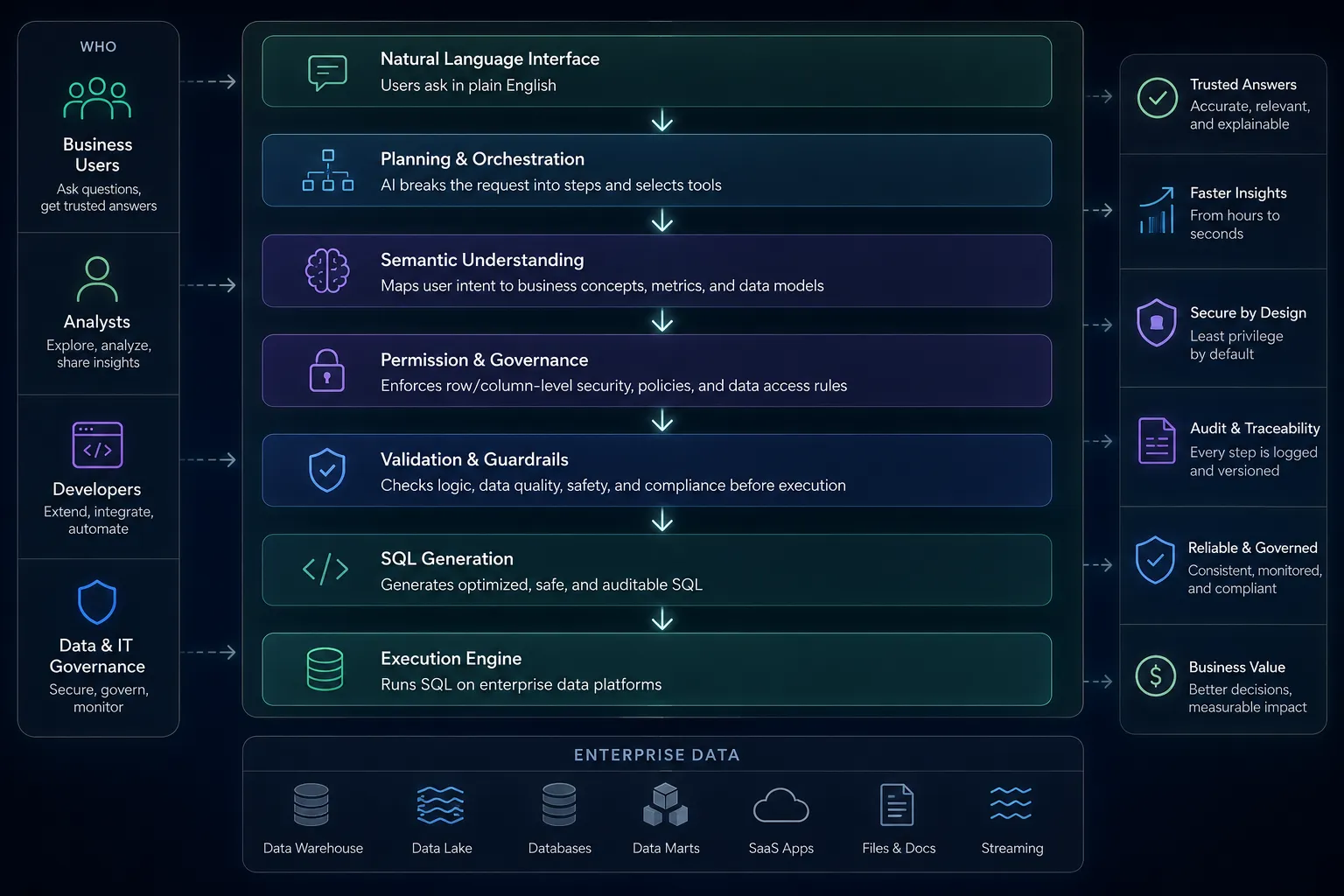
The reference stack. The model is one layer; the other six are what make its output trustworthy.
Where Savvina Fits in This Stack
Laid out as a stack rather than a pitch, enterprise AI for analytics looks like this: business users ask a question in natural language, an agent plans and reasons about it, a semantic layer translates business terms into actual schema, a permission layer enforces who’s allowed to see what, a validation step checks the generated query before anything runs, and only then does execution happen against the real data warehouse.
Savvina sits in the middle four layers of that stack — semantic understanding, SQL generation, validation, and permission-aware execution — self-hosted, running against your choice of LLM, and compatible with the warehouses most enterprise data teams already run: PostgreSQL, Snowflake, BigQuery, Databricks, MySQL, Redshift, ClickHouse, and 22 data sources in total.
It’s the layer between “a model that can write SQL” and “an answer your data team would actually sign off on.”
FAQ
Why do most enterprise AI agent pilots fail to reach production? Gartner attributes most agentic AI project cancellations to escalating costs, unclear business value, and inadequate risk controls — not model capability. MIT’s NANDA research similarly found the gap is driven by integration and workflow adoption rather than the underlying models.
Is self-hosted AI still relevant when frontier models keep improving? Yes — self-hosting addresses a different problem than model capability. It keeps sensitive schemas, query logs, and raw data inside an organization’s own perimeter while still letting a best-in-class model do the reasoning.
What’s the difference between a chatbot and an AI agent in 2026? A chatbot answers a question from what it already knows. An agent plans, calls tools such as a live database or document store, validates its own output, and only returns an answer once it can support it against a real source.
What makes natural language analytics harder than other enterprise AI use cases? Analytics questions have exactly one correct answer sitting in the data. Unlike a chatbot response, a wrong SQL query doesn’t just read poorly — it returns a confidently incorrect number, which is why validation and a semantic layer matter more here than almost anywhere else in enterprise AI.
Can an AI agent be trusted to query a production data warehouse? Only with enforcement it cannot talk its way around: read-only execution at the validator level, row-level filters and column-level exclusions applied to the generated query, and an audit trail of every question and the SQL it produced. Trusting the model’s good intentions is not a control; blocking mutations before execution is.
Do you need a semantic layer for text-to-SQL to work? For a toy schema, no. For a production one, yes — because business language and schema language differ. “Active customer,” “bookings,” and “fiscal quarter” have specific definitions in your organization that appear nowhere in a column name. The semantic layer is where those definitions live, and it’s the difference between a system that answers your questions and one that answers questions about your column names.
Where This Leaves Us
The biggest story of AI in mid-2026 isn’t that models became smarter. It’s that enterprises finally discovered intelligence alone was never enough. Production AI depends on trusted data, permission-aware architecture, observable workflows, and systems that can explain every decision they make.
That’s why the next generation of AI platforms won’t be defined by which model they use, but by how well they connect that model to real business systems. For analytics, that means translating natural language into verified, traceable SQL — not just a plausible-sounding answer.
As organizations move past pilots and into production, the winners won’t be the ones with access to the most powerful models. They’ll be the ones that built the most trustworthy system around them.
See the reference stack in action against your own schema: get started with Savvina — self-hosted, bring-your-own-LLM, permission-aware by design. The Community Edition is free under BSL 1.1, converting to Apache 2.0 in 2030.
Further Reading
- Text-to-SQL for PostgreSQL: A Complete Guide (2026)
- The Reasoning Revolution: How the Latest AI Advancements Are Reshaping Text-to-SQL
- Text-to-SQL vs. Traditional BI: Which Is Right for Your Team?
- The Rise of Self-Hosted AI Analytics
- Natural Language to SQL: The Future of Data Access or Just Another AI Trend?
- Introducing Savvina: Self-Hosted Natural Language to SQL in 5 Minutes
References
- Gartner, “Gartner Predicts 40% of Enterprise Apps Will Feature Task-Specific AI Agents by 2026, Up from Less Than 5% in 2025” (August 2025) — gartner.com
- Gartner, Hype Cycle for Agentic AI, 2026 — gartner.com
- Gartner, “Gartner Predicts Over 40% of Agentic AI Projects Will Be Canceled by End of 2027” (June 2025) — gartner.com
- McKinsey & Company, “The State of AI in 2025: Agents, Innovation, and Transformation” — mckinsey.com
- MIT NANDA / MIT Media Lab, “The GenAI Divide: State of AI in Business 2025” (July 2025), as reported by Fortune — finance.yahoo.com
A note on sourcing: several widely circulated “80% of enterprise apps embed an agent, up from 33% in 2024” and “31% in production” figures trace back only to secondary aggregator blogs rather than to Gartner or S&P Global directly, and have been left out of this piece for that reason.