Shipped Doesn't Mean Adopted: The Questions Product Teams Can't Afford to Wait On
Launch day is the easy part
Three weeks ago, your team shipped the new onboarding checklist. The release went smoothly, the announcement collected a few emoji reactions, and the sprint closed green.
Then someone in the leadership meeting asks: “Is anyone actually using it?”
You don’t know. Not yet. You have a feeling it’s working, maybe a couple of anecdotes from support. But a feeling isn’t an answer, and the question will be back tomorrow.
Every Product Manager knows this moment. The work is done. The evidence isn’t.
The queue between you and the answer
So you do what you always do. You check the dashboard, which shows signups and overall activation but nothing about the checklist. You open a ticket for the data team and answer two clarifying questions: which users count as “new,” and what counts as “completed.”
The analyst is capable and busy. They are also working through requests from marketing, finance and three other product teams. Your question isn’t hard. It’s just in line.
And sometimes, the hardest part isn’t getting the data. It’s figuring out exactly which data is needed to answer the question.
When the numbers arrive, they raise a better question. Do people who finish the checklist retain better? Does it differ by plan? That means another ticket, another round of explaining, another wait.
None of this is anyone’s fault. But a decision that could have been made on Tuesday gets made the following week, or gets made on instinct.
Shipped is not adopted
Shipping a feature is an engineering milestone. Adoption is a product outcome. The gap between the two is where most product learning happens, and it comes down to a handful of questions:
- Activation: What share of eligible users tried the feature at all?
- Drop-off: Which step loses people along the way?
- Segments: Which customers use it, and which never touch it?
- Impact: How does retention or conversion differ between users who adopt the feature and those who don’t?
- Progress: Did adoption improve after the latest release or onboarding changes?
These are ordinary questions. The trouble is that each one depends on the answer to the one before. A slow answer doesn’t cost you a day. It can delay the whole chain of investigation.
Dashboards answer yesterday’s questions
Dashboards and product analytics tools are essential. They make established metrics visible, help monitor trends and support predefined investigations.
But product discovery doesn’t always follow a predefined path.
Say conversion dipped last month. The dashboard shows the dip. It doesn’t necessarily show whether the drop is concentrated among customers who used the new feature, came from a particular channel, or signed up on a particular plan.
That requires a new investigation. And product discovery is made of these investigations: unplanned, specific, and often worth asking only once.
A dashboard tells you what you already thought to measure. Good questions reveal what you missed.
A different workflow: ask the data directly
Imagine the same Tuesday with a different path.
You type a question in plain language against your product database:
“Of the accounts created in the last 30 days, how many completed the onboarding checklist, and how many of those were still active after two weeks?”
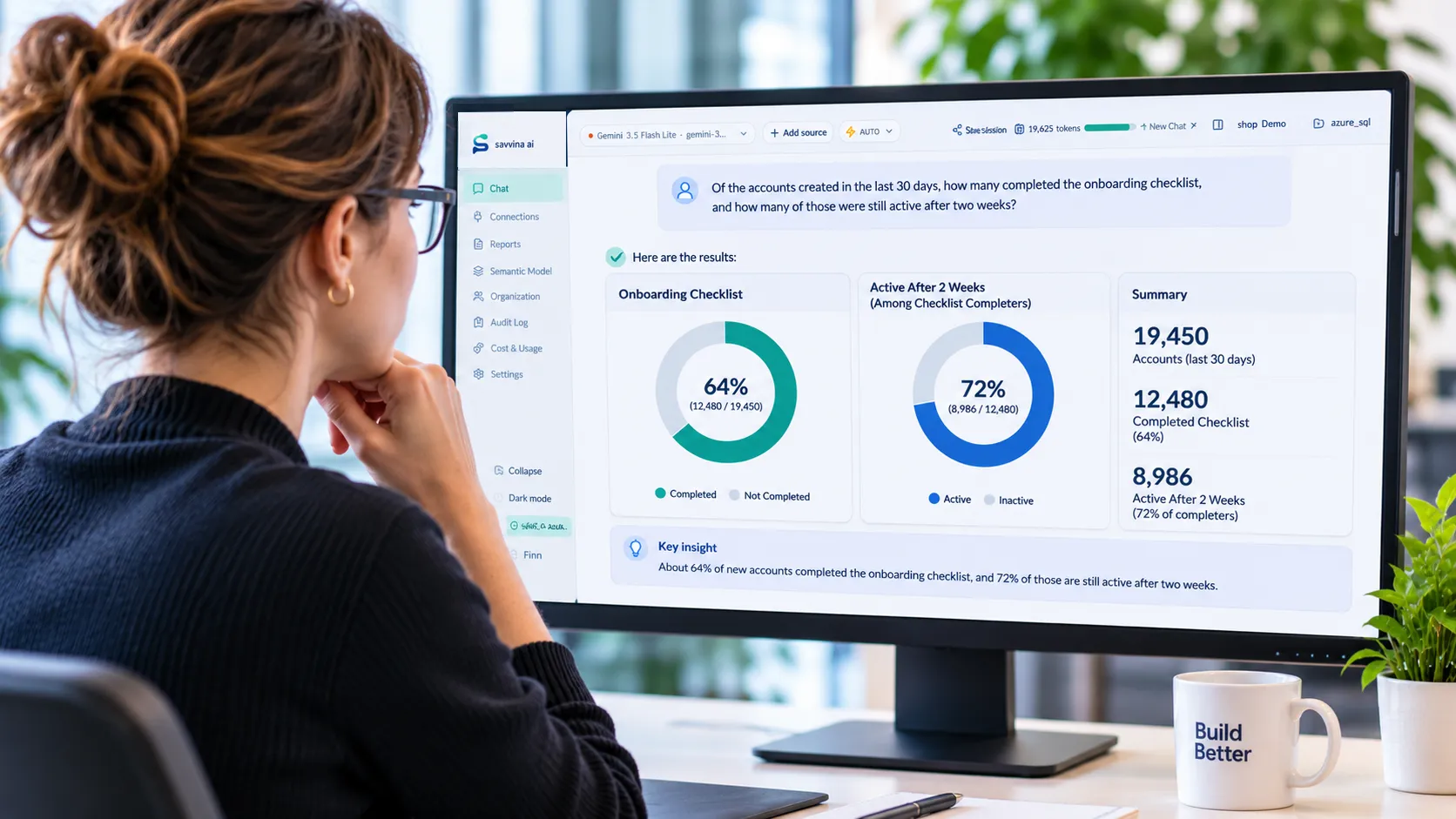
You get an answer. Something looks interesting, so you refine the question: split by subscription plan, then by signup channel. You discover that checklist completion is considerably higher among self-serve users than enterprise accounts. Now you have something concrete to investigate and bring into the next roadmap discussion.
Assuming the relevant product events and account activity are captured in your database, this kind of investigation becomes possible without translating every new question into another data request.
This is the idea behind natural-language-to-SQL tools such as Savvina: connect to your own data, ask questions in plain English, and explore the answers iteratively. The generated SQL remains visible, so you or an analyst can inspect and validate the query rather than trust an AI-generated answer blindly.
Savvina doesn’t replace dedicated product analytics platforms such as Mixpanel, Amplitude or PostHog. Those tools provide specialised capabilities for tracking and exploring user behaviour. Savvina complements them by allowing teams to investigate questions directly against their existing business databases, including information that may sit outside their product analytics environment.
It’s another way to explore the questions that emerge after the initial analysis, without necessarily creating another request for the data team.
What this means for data teams
Nothing here removes the need for analysts. Quite the opposite.
Much of a data team’s week goes to repeat requests: pull this cohort, count that event, rerun last month’s report. It is rarely the work they joined to do.
When Product Managers can answer routine questions themselves, analysts can focus on the work that requires their expertise: data modelling, experiment design, trusted metric definitions, governance and the questions where getting the answer wrong is expensive.
Of course, effective self-service analytics depends on having reliable data, shared business definitions and appropriate access controls. Without those foundations, faster answers don’t necessarily mean better decisions.
The healthy version is a division of labour. PMs explore, analysts establish the foundations and validate what matters, and the tickets that do arrive are fewer and better.
Evidence shouldn’t depend on availability
Features will keep shipping. What separates strong product teams is how quickly they find out what happened next.
Before your next launch, write down three questions: who should use this, where might they drop off, and what will we change if they don’t? Then ask how long each answer would take you to get today.
If the honest answer is “days,” the bottleneck isn’t your product sense. It’s the queue.
Product decisions should be driven by evidence, not by the availability of an analyst.
Explore the Product Managers use case: Funnel & Retention Analytics with Savvina